
State of Pain Management Private Equity
Summer 2024
Introduction
Pain management has emerged as a significant area of interest for private equity investors over the past decade. The specialty has witnessed steady consolidation of physician practices, with over 15 traditional private equity-backed pain management platforms currently active in the market. Compared to other medical specialties such as dermatology and eye care, the pain management sector has seen less consolidation to date and is very much in the early innings. This is partly due to the unique challenges it faces, including the uncertainty surrounding reimbursement policies and its proximity to the opioid crisis, among other things.
That being said, private equity interest has remained strong due to the prevalence of chronic pain affecting the American people, overall industry growth, and opportunities to create value through leveraging the scale of large platforms. Another driver is the ability of physicians to treat a broader range of clinical issues in the outpatient setting as part of overall musculoskeletal health, as well as the ability for physicians to bridge the gap between medication management (opioids, etc.) and non-pharmacological, pain management solutions.
Pain Management Trends
Trend 1 – Clinical Demand
Chronic pain affects millions globally, with approximately 20% of adults in the United States alone dealing with pain. The global postoperative pain management market size is projected to reach $63.8 billion by 20331, indicating a substantial and growing demand for effective pain management solutions.
Trend 2 – Regulatory Environment Driving Non-Pharmacological Alternatives
Regulatory changes, especially increased scrutiny on opioid prescriptions, have spurred the demand for non-pharmacological pain management alternatives. For instance, the U.S. government has allocated significant funding for research and development in pain management, signaling support for innovative solutions in the sector. The integration of behavioral health support with pain management services is gaining momentum due to a growing understanding of the interconnectedness between physical and mental health. The global behavioral health market, forecasted to reach $261.8 billion by 2029 compared to $205 billion in 20212, should continue to enhance the ability for investors to benefit.
Current Pain Management Platforms
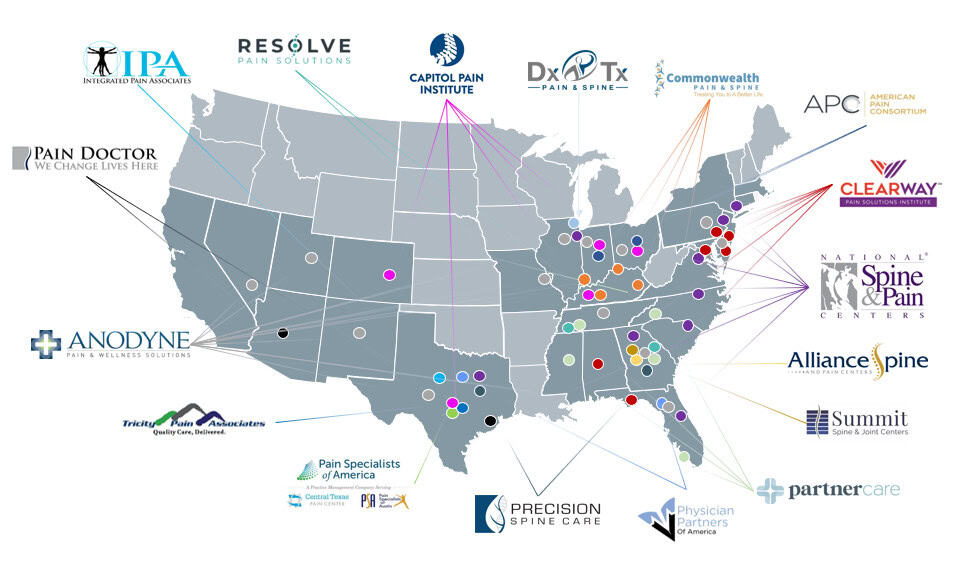
Currently, there are over 15 traditional private equity-backed pain management platforms operating in the US. These platforms employ a mix of regional and national geographic strategies, with a concentration in the east coast, southeast region, and midwest markets. Notably, the South-Central market, particularly Texas, has emerged as a hotspot for pain management platforms, with nine platforms operating in the state. Furthermore, several private equity firms with extensive experience in provider services consolidation have shown interest in entering the pain management sector, indicating sustained growth and investment potential.
Additionally, PGP has insight that numerous new platforms backed by private equity are in the works; firms whose focus is on maintaining clinical autonomy for their physician partners and adding fuel to the fire where they can add value administratively and operationally. This trend is encouraging pain management groups who previously hesitated exploring private equity, to reconsider.
Why Now?
Legacy PE platforms vs New Private Equity Entrants
Some of the early private equity firms to invest in pain management struggled to succeed, while investments in recent years have been mixed. Currently, in what PGP is terming private equity 3.0, legacy PE investors and new market entrants have learned from previous mistakes, and the ability for platforms to better understand how to truly create value bodes well for practice owners considering a sale. This level of sophistication is also causing new interest from new private equity firms who have yet to invest in the specialty.
Opportunistic Value Creation – Inpatient + Outpatient
A significant factor driving private equity interest in pain management is the shift from inpatient to outpatient settings, as well as the ability for groups to bridge the gap between medication management and neurological/pain management. As private equity firms have gotten smarter in the space, their ability to partner with practice owners and assist in the development and acquisition of ancillary services across inpatient and outpatient settings has never been greater.
This evolution of serving a more holistic patient population across care settings not only improves the patient experience but also creates additional revenue streams and cost-saving opportunities, leading to stronger leverage and competitive advantage, which PGP utilizes and leverages during the transaction process.
The number of exploratory discussions PGP has had in recent months with pain management groups looking to become more educated on their strategic options has never been higher. We anticipate an increase in activity in the latter half of the year and heading into 2025, as groups build up cash flow reserves and interest rates stabilize.
Key Considerations For Practice Owners & Why an Advisor Is Important
When evaluating a potential partner, it is extremely important to find the right fit to ensure a strong go-forward partnership. PGP advises that four critical factors need to be considered when evaluating whether a partner is right for your practice
- Maximize Economics and Achieve Most Favorable Deal Terms
- Negotiating favorable economic deal terms (equity share price, timing of payment, etc.)
- Strike appropriate balance between total EBITDA credit vs the EBITDA multiple
- Receiving credit for various tangible growth initiatives in the business (new locations, new providers, new service lines, etc.)
- Achieve Clinical Autonomy
- Ensure there is a strong level of go-forward governance control at the local level
- The practice maintains directional control at the company, including work schedules, vacation days, work location, and retention of staff
- Maintained control of provider recruitment and retention
- Ensuring potential partners have the resources to execute against the strategy
- Access to capital and economies of scale
- Adequate level of administrative and operational resources provided (Accounting / Finance, IT, RCM, Marketing, HR & Recruiting, Business Development, Legal, etc.)
- Track Record of Success
- Partnering with experienced healthcare / PPM ‘Operating Partners’ with a history of adding significant value and operational guidance in the PPM space
- Proven ability to align with young and newly recruited providers
- Exceptional key performance metrics (recruitment, attrition,location growth, service line expansion)
While many independent groups may initially feel they can navigate a transaction without an advisor, those that have gone through the process with an experienced and reputable firm in their corner will be quick to highlight the significant value add from both economic, partnership and educational perspectives. Ensuring that each shareholder is prepared and fully understands the dynamics within a transaction is crucial for the future success of the business.
A seasoned healthcare transaction advisory team can ensure that the most attractive outcome is achieved. Through a formalized competitive marketing process, an advisor can ensure the practice maximizes their economics and transaction terms. A transaction process also allows the practice to interview multiple private equity partners and choose the group that presents the best ‘fit’.
Even if a group is approached by a buyer or has a buyer in mind, it is essential to run a process considering the practice has one opportunity to choose the right private equity partner, supplemented by the value a process drives regarding both deal terms and economics.
Creating Value after the Transaction
After completing a transaction, significant value can be generated by implementing strategic initiatives aimed at driving growth, improving operational efficiency, and enhancing overall performance. These initiatives may include expanding service offerings, optimizing revenue cycle management, implementing technology solutions to streamline operations, enhancing marketing and patient acquisition efforts, and pursuing strategic partnerships or acquisitions to broaden the practice’s footprint.
The impact of these value creation efforts on the owners’ equity left in the business can be substantial. With a stronger and more profitable practice, the owners’ equity stake is likely to appreciate significantly over time.
Moreover, the private equity firm’s involvement can help professionalize the practice’s management, strengthen corporate governance, and implement best practices in areas such as compliance, risk management, and strategic planning. These enhancements not only contribute to the practice’s long-term sustainability and success but also increase the attractiveness of the business to potential future investors.
In summary, by partnering with a private equity firm, healthcare practice owners can leverage industry expertise and resources to unlock the full potential of their business, driving value creation and ultimately maximizing the value of the business. It is imperative however to have the right advisor on your side, to help navigate through the complexities of these transactions.
Private Equity Value Creation

Gaining Payer Leverage

Capturing In-House Ancillary Services

Centralizing Infrastructure and Operations

Resulting In

Sustaining Organic Growth
Conclusion
The consolidation within Pain Management continues to accelerate into the second half of 2024 and PGP expects the pace to continue into 2025. Whether a practice outwardly desires private equity partnership, questions the rationale and effectiveness of a PE partner, or downright disagrees with private equity, it is essential to get educated and ensure your practice is positioned for continued success in your market.
For those that choose to go down the path, it is imperative that culture and alignment, not simply economics, is the first goal. The role of an advisor like PGP can be the difference maker not only in knowing who can be trusted and who has a track record of success, but in ensuring an economic outcome that is satisfactory when transferring the ownership of your business.
If interested in pursuing a transaction, learning about private equity, the private equity strategy, transaction dynamics, or activity in your market, please utilize the information below to contact the PGP team and schedule a discussion.
Sources & Citations
Physician Growth Partners · This content is provided for informational purposes only and does not constitute legal, financial, or investment advice. All transaction data sourced as cited. © 2026 Physician Growth Advisors, LLC. All rights reserved.
Data You Can Rely On
Latest Market Updates






Considering a healthcare transaction? Start with a confidential conversation.
"*" indicates required fields